Trajectories of post soviet states
Trajectories of Post-Soviet States
( What tools do they have to help our imagination )
“Today we see liberal capitalism and its political system as the only natural and acceptable solutions. Every revolutionary idea is considered utopian and ultimately criminal. We are made to believe that the global spread of capitalism and what gets called “democracy” is the dream of all humanity and that the whole world wants the authority of the American Empire, and its military police, NATO.”
– Alain Badiou
At time in which a conflict located in Eastern Europe has not seen the headlines to this degree since the Kosovo fiasco in 1999, the construction of public opinion is the first front where respective geopolitical entities of West and East stake claims for the outcome of the future. The situation in Ukraine provides a critical insight into the production of western democracy in it’s reframing of perspectives from cultural regions previously peripheral to it. A deeper dialogue into the effects of the transformation in subjectivity within Eastern Europe enables us to draw upon a collective memory that keeps a counter history. This can provide us new questions about our own world, transcending cultural confinement.
What is most misleading from the hysteria of the press is presentation of an event from a strictly political context and not from a cultural one or about the flows of powers and identity. Contemporary politics has reached the status of simulacrum, where the production of decisions occurs “at the highest level” and are framed in connection with the election, the president or parliament, armed conflict, or changing of the cabinet, summits, political scandals, and so on. 20th century democracy has been framed predominantly as a “representative” process and one that is inconceivable without also the idea of 20th century capitalism, as such this representation now happens only for the elite.
The becoming of former Soviet states into independent republics over the last two decades is inseparable from the forces of economic liberalization and digestion/appropriation of western cultural forms. The social and cultural processes, which were shaped over hundreds of years in the West, occurred suddenly in Eastern Europe at an accelerated tempo, bringing continuous life tensions in those nations including the inconstancy of history and memory, and ongoing complications of identity.
As such, the present moment is embedded within the process of machines already at work throughout the Eastern Bloc way before the first headline. ‘Europe’ for the protestors functions as a myth just like the USSR was a myth for too many radicals in the 1930’s. Former soviet countries that have joined the EU now are subject to modernized austerity, encompassing a deeper cycle of neocolonial control, cultural, political and economic. A key part crucial to be encoded into the culture is the myth of ‘making it’. People are led to believe that they all can ‘make it’ in terms of economic mobility, while the rewards of this dream in reality are reserved for the elite few. Those who do make it do so just enough to perpetuate the myth that those who fall to the side are victims of their own shortcomings.
Despite the desire of the EU to include more nations into it’s sphere, there is a crisis at it’s core. The financial crisis of 2008 has exposed the fundamental unsustainability of debt financed democracy. The Evangelical nature of this process masks the desire to quell these undercurrent anxieties. Secondly, democratic values and principals come to act as a rhetorical tool to cover for the implementation and legitimation of quite other purposes, such as an economic advantage by having easy access of cheap labor force from the East.
The choice to embrace this myth embodies the success of using culture as a tool for the dissemination of ideology and in shaping of policy by the West. The protest could have been about raising the quality of life as a whole, but instead it was spurred around alignment and integration with the EU. Those who have joined the EU transitioned from being under one Empire to another, only that the new overlord is not so much a physically occupying force but one of the mind. Instead of palaces of culture it builds shopping malls called “Panorama” and “Manhattan”. There are however, other exit points for regions that have yet to arrive at this juncture, specifically Belarus, a country that has many similarities to Ukraine yet lacks the nationalist confrontation or the extreme degree of privatization and eroded social infrastructure.
Two terms curial sculpting the climate in the 90’s in post-soviet society were Shock therapy and Gradualism. Both economic terms created a strategic approach to reshaping society to adopt western values from infrastructure to social relations.
Shock therapy is loosely defined as “the sudden release of price and currency controls, withdrawal of state subsidies, and immediate trade liberalization within a country, usually also including large-scale privatization of previously public-owned assets” Under the pretext that a country is sick and that improvement comes though the economy. Some dubbed this as the “Surgery” approach – it will be painful now but will get better quicker. Gradualisim is a slower process of deregulation, more attentive to social aspects of transformation, akin to “medication” – trying of different things to “heal” from state control. Applied in China, Central Asia and Belarus, these process where drawn out to be less painful. They wanted to avoid things like people being jobless for a decade and the shutting down of industry.
In the 80‘s many of the republics sought ways out of the Soviet Union though the adoption of historic reference points. Baltic republic’s fight for democracy was based on the notion of reestablishing a glorious nation state, a romanized myth of a return to the past and rebirth of culture. The other states wanted to follow the footsteps to the utopia of Western Europe. Belarus however differs in adopting neither forms of Utopia. There was never a base for national identity of what they were in the past. In addition to their borders shifting significantly after WWII, they had at one time shared parallel cultural histories with all of their bordering nations. Due to modes of socialization and behavioral patterns they did they see western European capitalism as an inevitable utopia. Their national identity used the soviet past as a base for it’s construction. To load empty Soviet symbols with new meaning as the brick and mortar of a new history. This created it’s own set of problems, but ones of fundamentally different character than of Europianization. It told history from a perspective that made conflict less of an emphasis on the shaping of the present day nation, instead focusing on the forces of WWII.
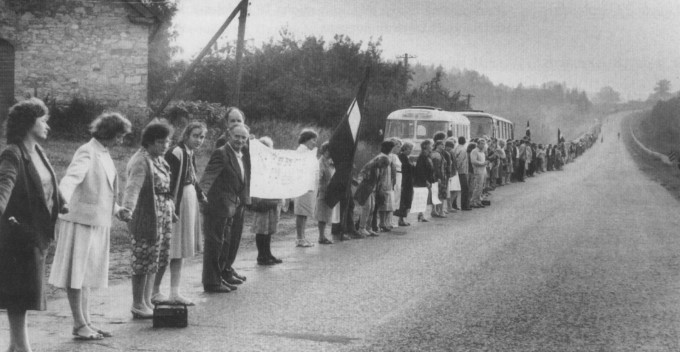
To read these transformations in terms of the flows of social power, there was a period where the harnessing power from within had it’s glimmer, before it dissipated once again to serve the power from elsewhere. A great example of this was when the three Baltic countries formed a human chain of some 2 million people, called the Baltic Way. It stretched from Vilnius, Lithuania to Tallinn, Estonia in a show of solidarity together in order to secede from the USSR.
Unfortunately, since that moment the shared opinion is that the countries began to drift further apart in the process of seeking out their own roots and differentiation.
Here began the building blocks of a new narrative. Social organization that came out of the 90’s was balanced along the ‘performance principal’, a modality of stratifying society according to the economic performance of it’s members. Before there was significance in ideology and principals, these bankrupt signifiers for desire are now filled with consumer culture and individualist values. The dream of a communist utopia swapped out for the American Dream introduced a new medium of exchange. It deterritorialized all other values and re-coded them along lines of capital. The result was the loss of self-worth and belief in people’s own ‘content’, leading to an acquiesce in one’s own exploitation.
If the West embodies ‘content’ and culture, in light of the local culture’s diminished position, then increasing amounts of energy are devoted to further their ends instead of ones own. The starkest example of this are the waves of “guest workers” that flock to the United Kingdom, Germany, and elsewhere. A large percentage of particularly young people go abroad to work jobs considered undesirable for the natives. They say there are no jobs in their own country that pay a living wage even though they have joined the EU.
This functions as a loop; it is though dissemination along cultural currents that neo-colonialization is able to take root. This was not a purely exterior force. The zealous attrition to the west was a distancing tool from the oppressive Soviet systems that were a focus of resentment. There was a hope in the open border as a source for new opportunities for self actualization.
An official definition of neo-colonialisim: The geopolitical practice of using capitalism, business globalization, and cultural imperialism to influence a country. Describes the socio-economic and political control that can be exercised economically, linguistically, and culturally, whereby promotion of the culture of the neo-colonist country facilitates the cultural assimilation of the colonized people and thus opens the national economy to the multinational corporations of the neo-colonial country.
Time has taught valuable lessons during trying their hand in neo-liberalism, and there exists a certain degree of fallout; a disappointment with the ‘reforms’ and deliverance to the promise land/utopia of capital. People are developing the capacity to critically reflect on their position in these past 20 years since things spun into action.
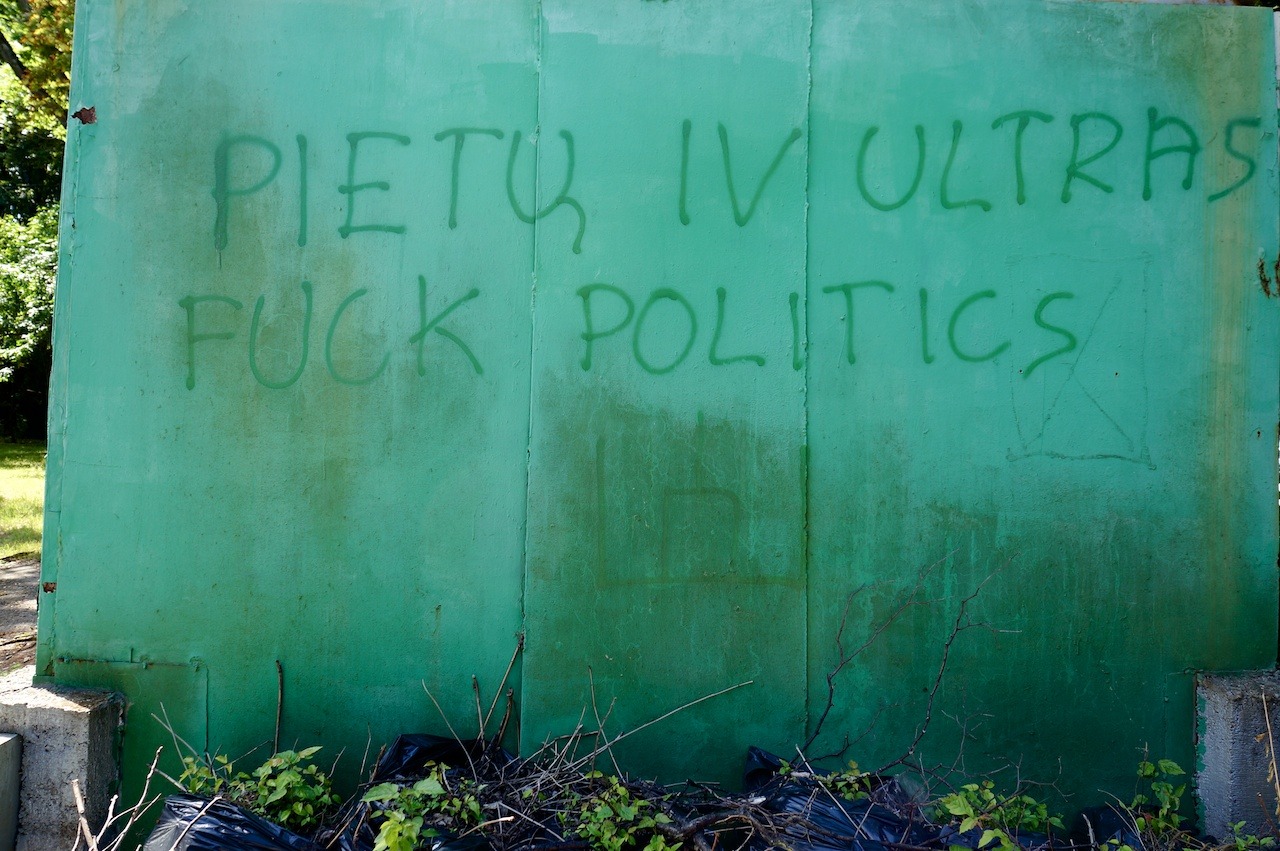
This will perhaps lead to some sort of self-determination movement that is neither haunted by the romanticization of the past nor naiveté towards capitalist centered reordering of culture and values. This negative collectivity has the advantage of not being fooled by the offer to have a seat at the table in representative democracy. It also comes out of becoming globally aware, avoiding the trap of nationalism. There has been a recent movement within art communities and activist circles for regional support surrounding issues of their common context. The other direction however seems to be the ambivalent embrace of Western European culture as their own, as having a voice in it. Present institutions encourage and channel discourse towards this modality through grants and awards for those whose message is ideologically compatible. Despite the lean toward having a reality that bears closer resemblance to that of the US/EU there are some factors present in these regions that are unique in juxtaposition to other “developing/modernizing” countries under globalization. They work to modulate that path to provide a different arrangement, despite their erosion.
There stills exists the notion of the local hospital, along with the rest of surviving welfare infrastructure, the commons still have a presence in the social psyche. These things are taken as a given despite the worldwide trend of austerity that cuts public service. This also manifests in the architecture that was built around a different set of values. The courtyard and it’s use as an intermediary between public and private space.
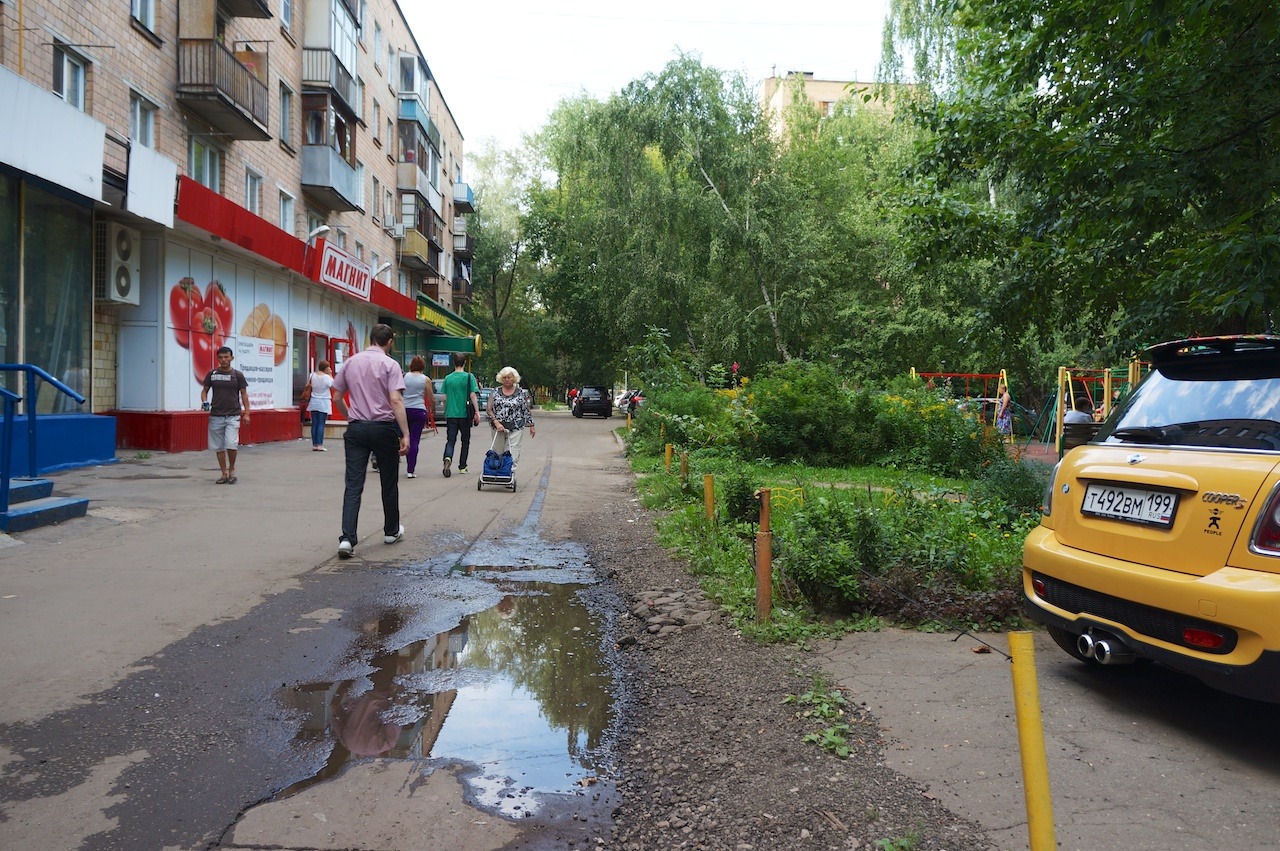
Personal networks of support still exist. In other industrialized countries individualization occurs and breaks this, but because of ineffective Soviet systems the networks of support existed. This is still the case today although it’s not quite of the same degree. This is particularly the case when it comes to food. During difficult times people grew their own food and were given land, barter networks existed. This was significantly active during the 90’s due to the instability and inflation.
There are extensive contacts with their own diaspora in the West and Russian cities, especially in artist/academic circles. This provides feedback loops either in support or in cultivating global awareness.
Forms of traditional multi culture exist. Despite the rise in nationalism there is exists a general acceptance of other nationalities as this was a part of the socialization during Soviet times. This is still felt more so than in Western Europe and their treatment of Muslims.
Belarus, while sharing the above factors also has a delay in cultural encroachments from the west. For example, the building of America style shopping malls is a fairly recent phenomenon there, where as this occurred ten years ago in the Baltics.
The soviet industrial infrastructure is still active and was never dismantled as it was in other regions; this is due to the extreme gradualism of privatization. The loss of jobs was never as severe as in the Baltics, and Belarus still continues to produce much of it’s own food supply as well as things like it’s own infrastructure: buses, trolleys, etc.
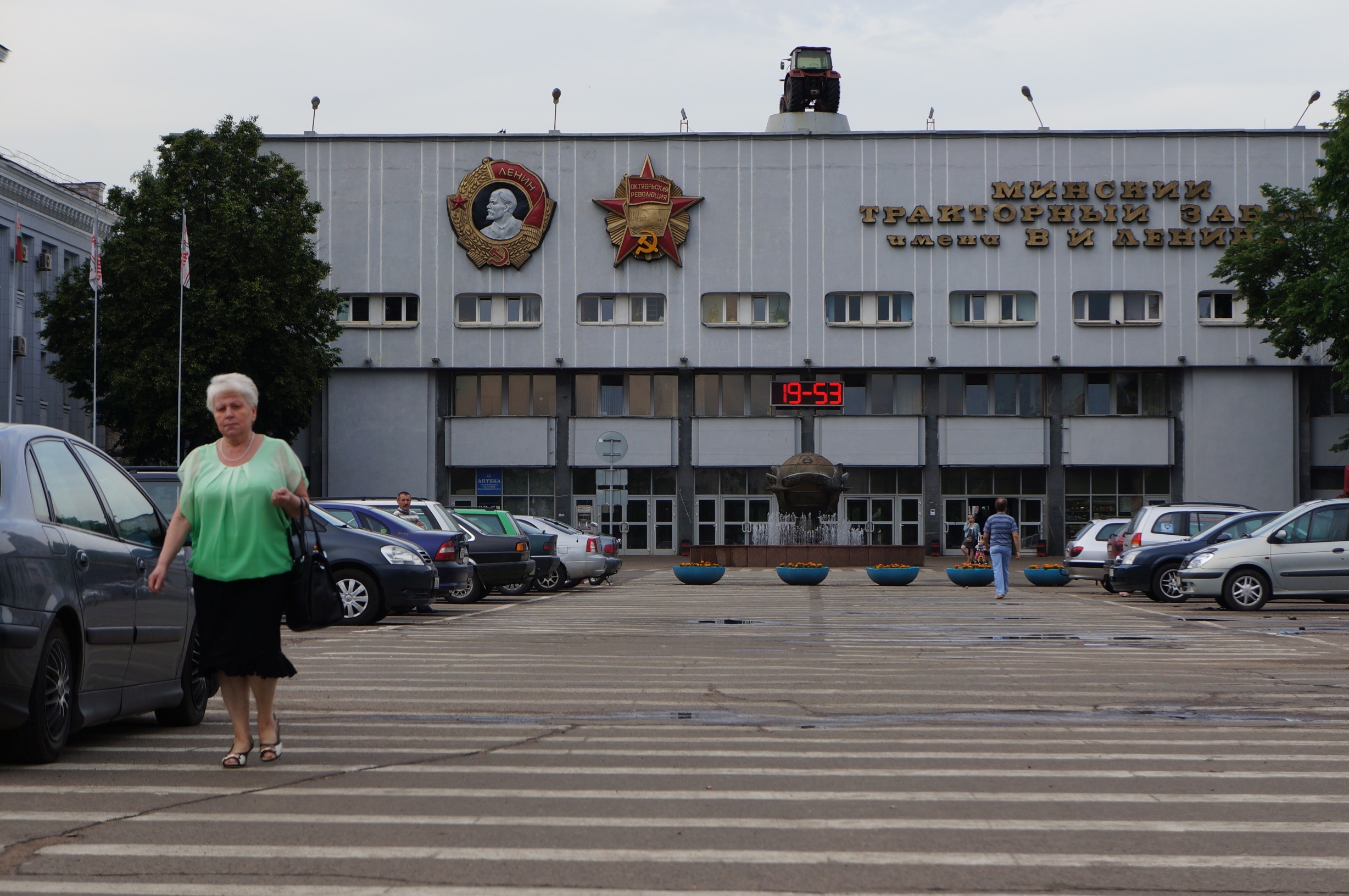
[ A soviet area factory in Belarus]
The result was only moderate transformation shock from the 90’s. This absence of disappointment with the transformation however meant that people still hold a Hollywoodized notion of capitalism. Rural areas, despite following in the global trend of depopulation, are still connected the economy as local producers and have an easier time surviving the turmoil. Public facilities and cultural spaces are maintained and used and are fairly easy to access and use for events. A hardcore punk show happens inside the “Tractor factory worker’s house of culture” while on the main floor elementary school aged kids run around. Not everything happens this peachy however. Just recently, the local Anarchist reading library was raided by the police because of some events they were planning.
To put this into perspective, what happened in the 90’s was the complete collapse of industry in most post socialist republics, and they still haven’t quite recovered. Ukraine has yet to reach the level of output it had prior. This is shock therapy. Once industry was privatized it tried to compete on the open market against western goods, meanwhile it broke contracts with Russia. All of the raw material for producing goods which once came from the East, now had to come from the West. The prices however were quadruple so everything closed down indefinitely. Those nations who joined the EU found themselves with a new map, having been granted certain business privileges being a part of Europe, they had become subject to the rules, policies and development agenda dictated by the EU, with equaling costs of products despite lower wages. They had gone from major exporters during the Soviet times to importers of the same commodities.
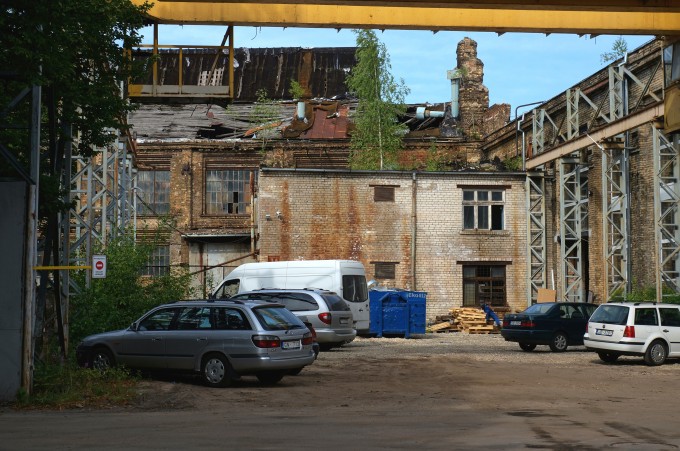
An example of this is the Solidarity movement that began in Gdansk, Poland in the 80’s. The movement was a new kind of union that aimed at autonomy from the agenda of the Communist party. This group of port workers was instrumental in Polish independence, the leader of which became Poland’s president in the 90’s. The port as it stands has been deindustrialized and what workers rights the movement fought for in the 80’s became irrelevant in the 90’s as a bouquet of neo-liberalizing forces continues to slowly decommission the port. Now there is a gigantic museum under construction, dedicated to Solidarity with romantically rusted steel exterior, showcasing the greatness of the movement, on the ground of it’s post-industrial wasteland.
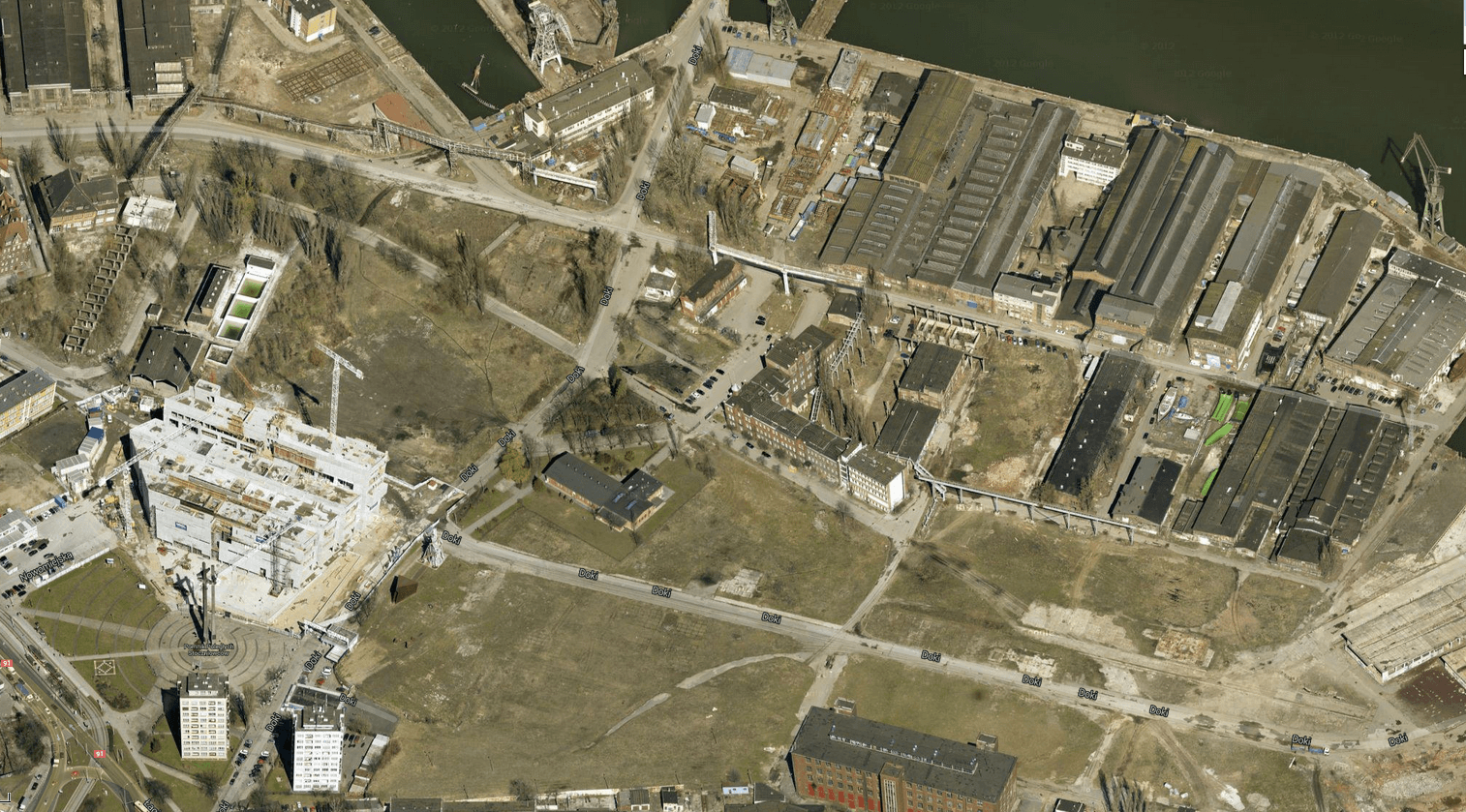
[ photo of vacant port and museum on left under construction ]
The immense amount of economic restructuring created a new class of people, originally dubbed “The new Russian” They were the vanguards of the transformation, taking advantage of the vacuum of control. Corruption came to function as a mode of economic being, embedded in the culture. Meanwhile, those who began the process of transformation in the 90’s are presently absent from the scene or have become the Oligarchs, unaccountable, and outside the law.
The myth purporting the image of success underscores the trend of this social gap: the acceptance of living on borrowed money. Older people remark that they are more hesitant to take out loans (“kredit) because of the conditions attached. Younger people feel more open to this process of taking loans on things they want to buy today and working it off later. This notion of working for money that you’ve already spent is seeping deeper into the everyday culture and is in parallel with the notion of a certain way of life being not up for debate. People are willing to work longer and harder to pay off their debt so that they can have that imported car, etc. Their desires stretch beyond their means and are directed to external markets. The situation is a microcosm of what is happening on an international level; tons of loans pumped into these countries to promote economic development, but these loans too come with their own conditions, as seen in Greece. In Belarus, despite this rising trend, the common culture remains fairly lean and economical so as a whole, all the business schemes that exist in the EU tend to not work there as well.
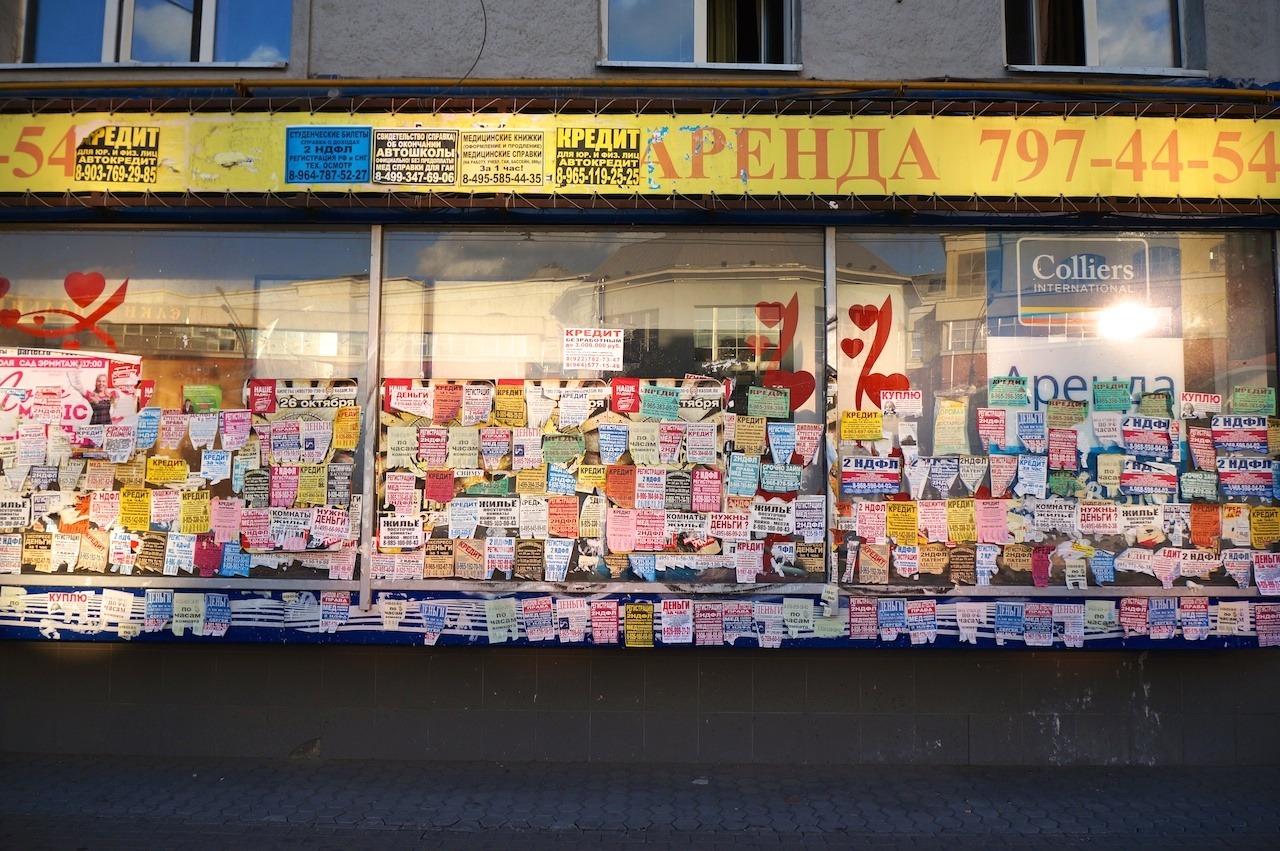
[ Ubiquitous advertisements litter the city offering money lending services. ]
After the harsh 90’s and the acceptance into the EU, scores of people went abroad to work crappy jobs for higher wages in the West, putting a strain on cultural retention and production. This process produced a brain drain from the said regions, and a gain of workers willing to do more for less in the West. Often a person in their 20’s can make five times as much working a service industry job in London then most common jobs in Lithuania. It has become common for many at some point in their youth to participate in this process and leave for months or years at a time. Upon return they bring the that culture with them. One can see England’s fashion aesthetics plastered all over retail stores in city centers, down to the iconography of the flag.
In Belarus the draw is weaker, there is less of a problem with unemployment despite low wages, there is a stronger feeling of social ties or solidarity between people and those who do leave the country usually do so to Russia which shares a similar cultural structure. There are however, many people who have left the country in the 90’s and have spawned a large diaspora in various western countries such as Germany and the United States.
The younger generation in general is raised under a new set of values and a different history. They tend to speak English as a second language instead of Russian, and see little opportunity in their own country and they are not interested in working industrial jobs, want in on the new economy. Hold a diminished value in engaging the older generations, considering them out of touch. A large section of the older population feel resentful of and disappointed in the claims for reforms after the collapse of the USSR. Many harbor notions of nostalgia for it as they are increasingly estranged from the world being built around them.
A woman in her 20’s remarks that there are not any kind of cultural activities that bring together the youth and the old; that there is nothing for them in the new world. They must feel abandoned and estranged, simply a background against which the new world of the free market is erected. There is the public spaces and the benches that they occupy; like some kind of refugees, with no place to contribute to society. They are in the villages and their kids come to visit them in the summer. Perhaps this is the place of refuge.
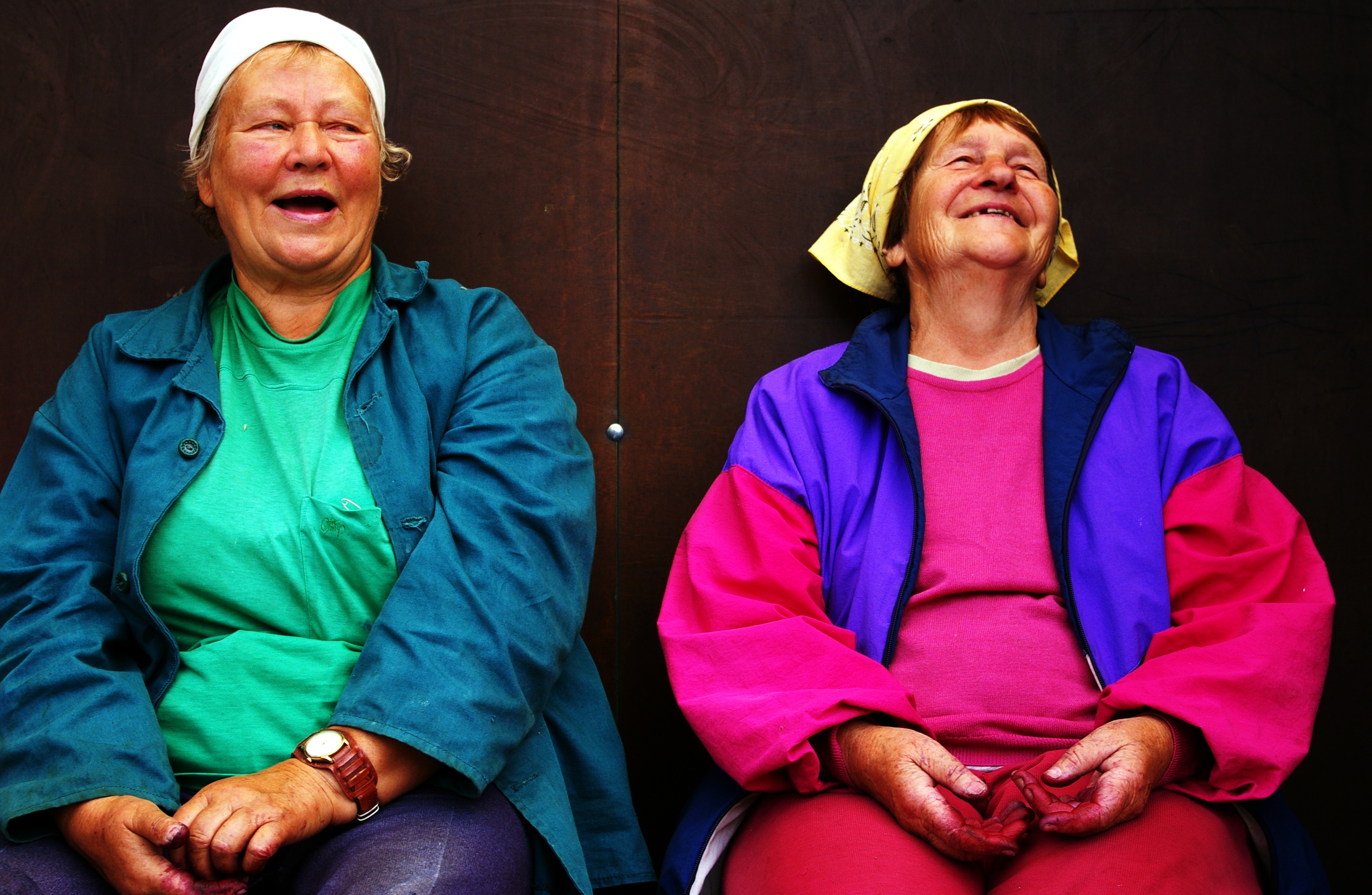
They are seen selling flowers of berries on the street to make money while their grandsons work as busboys in London or construction jobs in Moscow. This was a common story. One woman spoke of her time before the EU, they were difficult but for the section of the population who were small farmers or homesteaders they were able to make a living from selling produce, milk and other goods to the Coop. Many people did this and when the new rules of the EU came this broke the practice of small scale local production as a part of the food supply. Her milk could no longer be standardized as well as other independently produced goods. She did not want to become a big farmer, just supplement her income. As a result this made it more difficult for the older and rural population to get by working the land. Now she picks berries in the forest and sells them outside the super markets, this is now illegal, she does get shaken down by the cops from time to time.
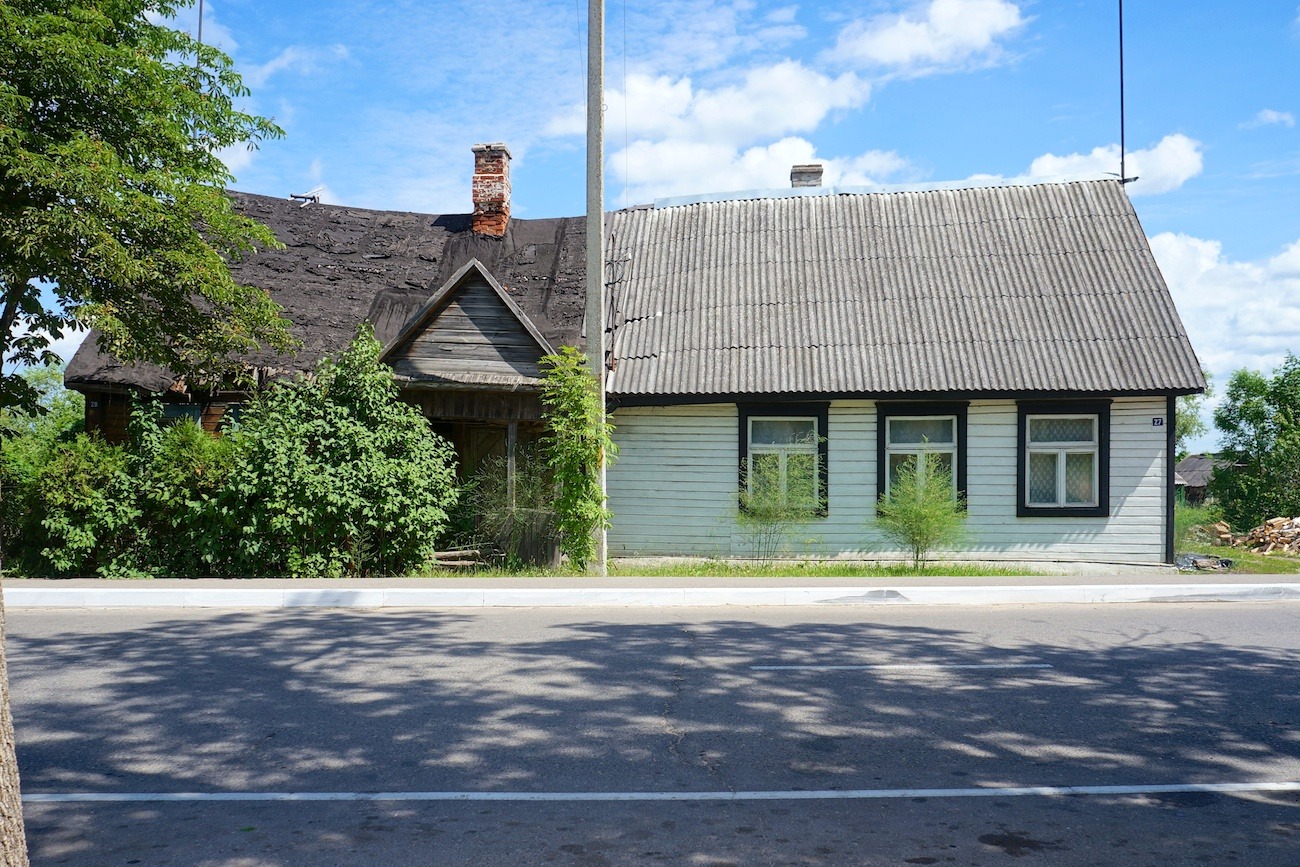
The rural regions, villages, and homesteads are buffered from many of the process of development. Ever since the dismantling of the previous system, the village became increasingly underproductive and less of place for cultural activity. Local food production has become unprofitable, because of the change in conditions.
Many people find themselves unable to pay for the most basic things, as they can no longer make their living off the land. There is a minority of them who have been able to jump of the development band wagon, getting loans and German made farm equipment, however others have no choice but to vacate the village and seek options in the city. It is mostly the aging population that stay in the villages. The youth are no longer interested in putting in the energy or support towards this way of life. Villages on the outskirts of the cities were the first ones to go. Their land was poached and slated for suburban development, either by individuals or by companies much like in the US. These are the gated communities of 50’s America, with a car in the driveway and a solid green lawn. Despite this form of existence falling out of popularity in the US lately due to it’s anti-social nature, here it is still a new frontier, reflecting the urge of individuation, and a desire to distance oneself from everyone.
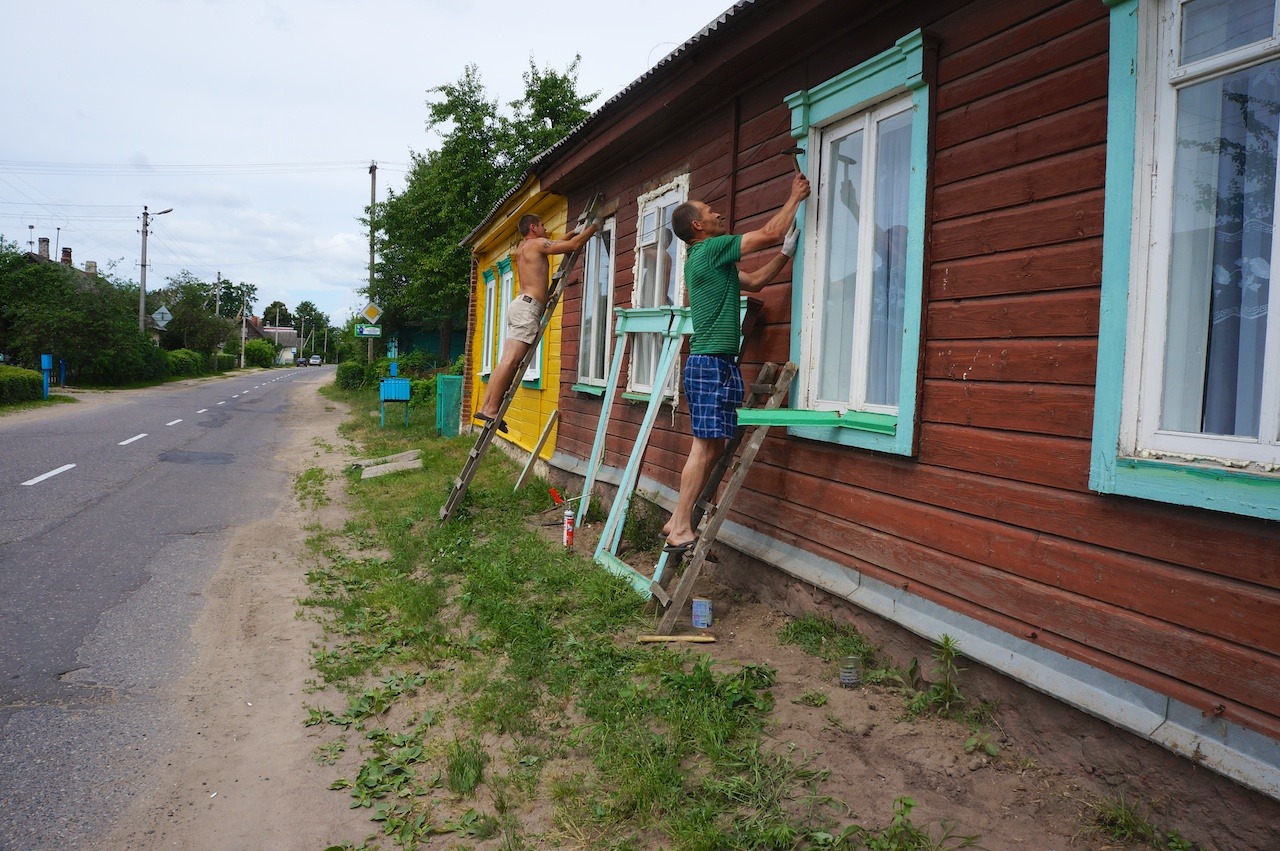
Throughout the 90’s many people subsisted on growing food in their summer cottages or parcels of land they had near the city. This was common among the majority of the population, as many were only a generation removed from having familial ties to the village. This practice has wained heavily, people prefer to buy produce from the store, even though they admit that it does not have the same quality. In Belarus, there are still factors holding the rural population together more so than in the EU. Teenagers in the villages said they intend to go to the city to study but want to return to the village to work again in some specialized field. Belarus remains a large producer of it’s own food, despite the population flux into the city, is trying to band together shrinking villages around a common production process, etc. The process of selling things from your homestead is a lot more accessible there than elsewhere. There is a significant labor base and a demand for goods that are cheaper to make locally than to import. Still the same trend takes shape, as housing costs rise in the center people take out loans to buy old houses on land outside the city in order to build a new building on the lot, commuting by car into the city for work.
Food follows a similar pattern. In the Baltic states, retail chains dominate food distribution. Maxima has 508 stores throughout the Baltics, and it is also the largest regional employer. Studies indicate that four biggest retail chains account for 76.4% of the market share for food consumption. It’s a big windowless box akin to a Walmart in the United States. People say however that this is an improvement from the 90’s. Pesticide use has increased significantly, going up 4 times it’s amount in 2000. A man from the country side of Lithuania says that now he makes his living as a salesmen for French chemical fertilizer. Roughly 34% of Latvia’s food is imported. The amount of foreign imports continues to climb each year as well as consumer spending on non local goods.
The city center has become a tourist trap in every capital city. The opening of the borders meant that now Westerners to come to fetishizingly gawk at Soviet iconography while exoticizing the old history of the city’s premodern era. The space of the city center in every country has a common thread that runs through it, that of Disneyland. In unison, these spaces come to resemble one another in their predictability and in their absence of real life unfolding. A testament to the jouissance of conspicuous consumption. In Riga there is a divide across street that one crosses to enter the “old center”. Locals don’t really go there anymore, just work the service industry jobs at the establishments. The police heavily patrol the area, protecting the drunk tourists stumbling along it’s cobblestone streets. Public space is polarized as either neglected or heavily commercialized; glass towers of international banks rise adjacent to them.
The same cycles of ‘gentrification’ run their course, with converted factory ‘lofts’ costing exorbitant amounts of money and neighborhoods being bought up overnight as investment properties. A factory partially converted as an artist space hosts a big party, hip-hop and techno performances in different rooms. A massive room with teenagers who idly sit on the couches pressed with their back up against massive soviet era book printing machinery, that is in places partially dismantled by vandals. An era of a new generation. Many decommissioned locations are used a sites for alternative events and music shows.
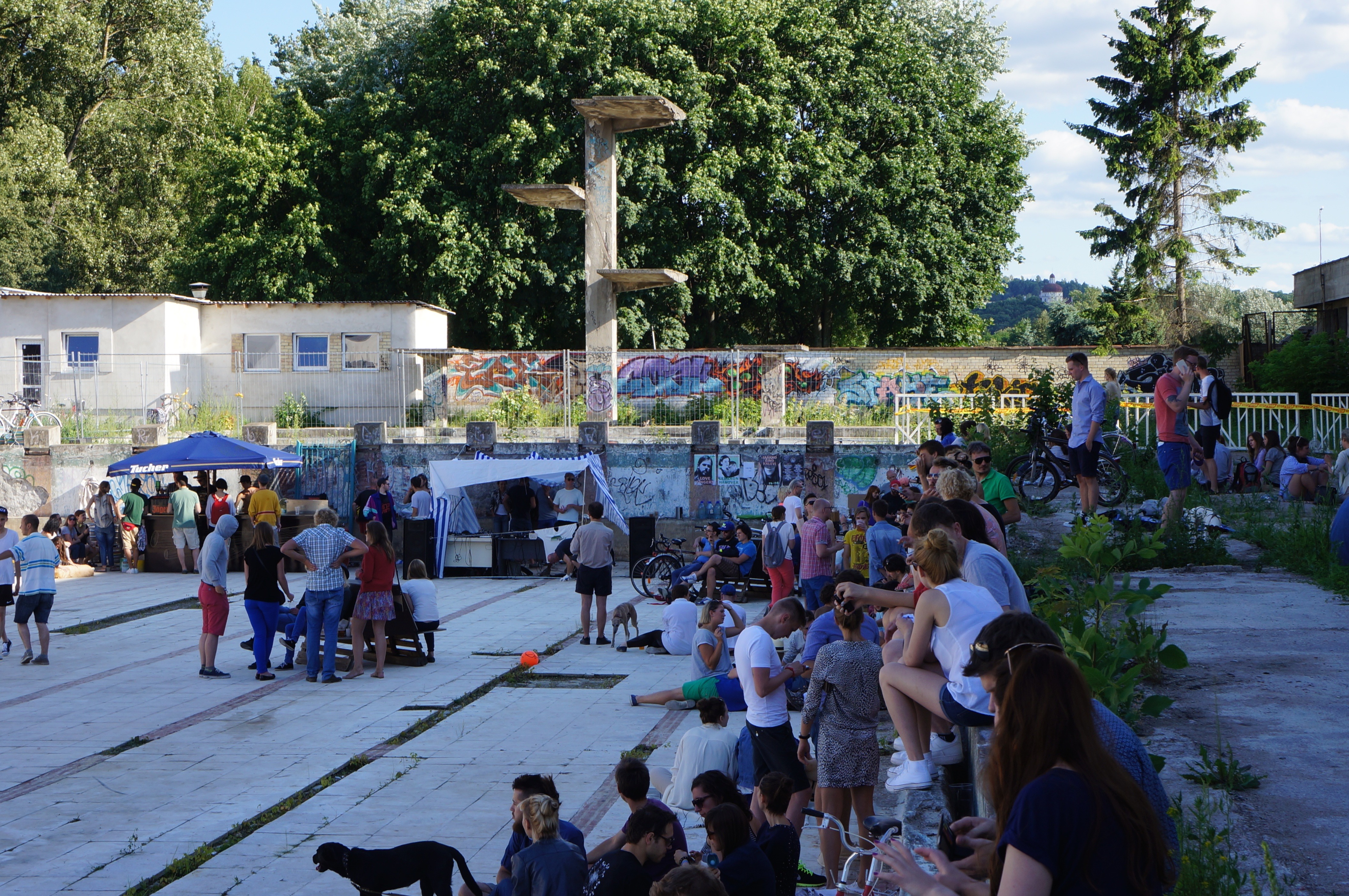
[ Electro show in abandoned Olympic sized swimming pool ]
The art world in Eastern Europe has had this inferiority complex, that like a spell, is just beginning to be broken. There was a time when if someone told you that your painting resembled Western aesthetics, it was a complement. Artists went to residencies at Western Institutions, replicating their structures back home; the white walled gallery became etched into a new geography. The discourse and structure are now becoming synchronized with the global notion of the ‘contemporary‘, a phrase which today in the age of multiculturalism and globalization goes untranslated across national borders and customs, sharing similarities with all those things American to which we grew so accustomed that we stopped noticing them a long time ago. This is a shadow that haunts creative expression when attempting to create independent culture or even plan festivals. Both the music and the medium of representation have the feel of adopted models. The format of presentation is overtly commercial, perhaps in an attempt to apply a level of professionalism and legitimacy. Even underground events in abandoned complexes had pop up shop style burgers and beer for sale from local establishments. The venues catering to hipster crowds rip on the “Brooklyn” bespoke aesthetic, tiredly repeated raw wood and vintage kitsch look. In this case once cultural production is commodified, it’s focus can be deflected to external markets.
Yet we have all seen the dangers, whence the art world reaches a certain amount of commercial traction; creativity and expression gain value as a function of monetization capacity. The New York art scene for example, is utilized for it’s representational, face value, and artists are thrown out and ignored as soon as the commodities they represent (neighborhoods, styles) reach a certain monetary value.
There are however, other emergent voices. Groups of people are developing work that addresses the issues that arise in the time and place surrounding them as well using the the exhibition space as a way to physically get people to talk and discuss ideas presented. This draw of the art world to the notion of community discussion and cultivation of the ability to speak is particularly interesting because evokes the notion that production of culture is the outcome of collective involvement and reflection, not just by art critics but by the so called civil society. During the USSR, the kitchen (within private) was a place where this kind of dialogue would occur, not so much in open debate out in public. As a result, people finding their power involves cultivating this ability to express one’s ideas in a rigorous manner, not simply preach to the choir.
In Belarus, many artists use their origin as a context for their work, often trying to expose political or rhetorical dogma of the government and examining themes of identity and representation as a part of a greater world around them. This is also dialogue happening within printed matter and the web as an extension of the above mentioned public discussion forums.
There however, the impassioned art remains largely underground. Those who are artists are in it not as a carrier, but as a way of working with the world. Even today there is still a feeling of the art world being cut off and isolated from the discourse that began to occur in post soviet countries. Of the initiatives and collective projects that came into being and flourished from the time of the perestroika through 1994, very few have survived and continue to play an important role in contemporary Belarus. As Belarusian philosopher and art critic Olga Shparaga says the Belarusian artists who were actively involved in the social-aesthetic renewal of Belarus roughly ten to twenty years ago have nowadays become either marginal figures or are involved in the cultural life of other countries.
The majority of art that comes from the support of public institutions is sanitized/neutered of politics or of any strong feelings that may be provocative. There is a stronger appeal to a works decorative qualities, with traditional emphasis on ‘folk art’. There are overt censorship strategies in place by the state that discourage a bigger independent art movement, the handing out of grants, exhibitions that need to be approved by the ministry of culture, etc. Some have dubbed it “the country with no galleries” and as such falling out of the category of the ‘contemporary’. The older generation of artists (who were given free studios by the state) provide a net of support to those who are emerging, often serving the roles of mentors and points of connection for opportunity and resources.
Here too is lies a possibility of imagining art outside of the diatribes of speaking in “International Art English” If state control could relinquish it’s entrenchment, how else can we envision art making that is not tied to the market? Also it asks the question: can one imagine being globally aware without being ‘contemporary’?
The EU gives money to restore ‘historic’ sites and buildings, or to rebuild them from scratch completely meanwhile the city is littered with soviet era cultural centers and sports complexes that are abandoned in ruins beside them. In 2008, the Berlin city government decided to demolish the Palace of the republic,(a cultural center during the GDR and still in use up to the moment of it’s demolition) and leave the empty area as parkland until funding for the reconstruction of a 15th century imperial palace could be allocated. (With proposed stone cutting done in Xiamen, China)
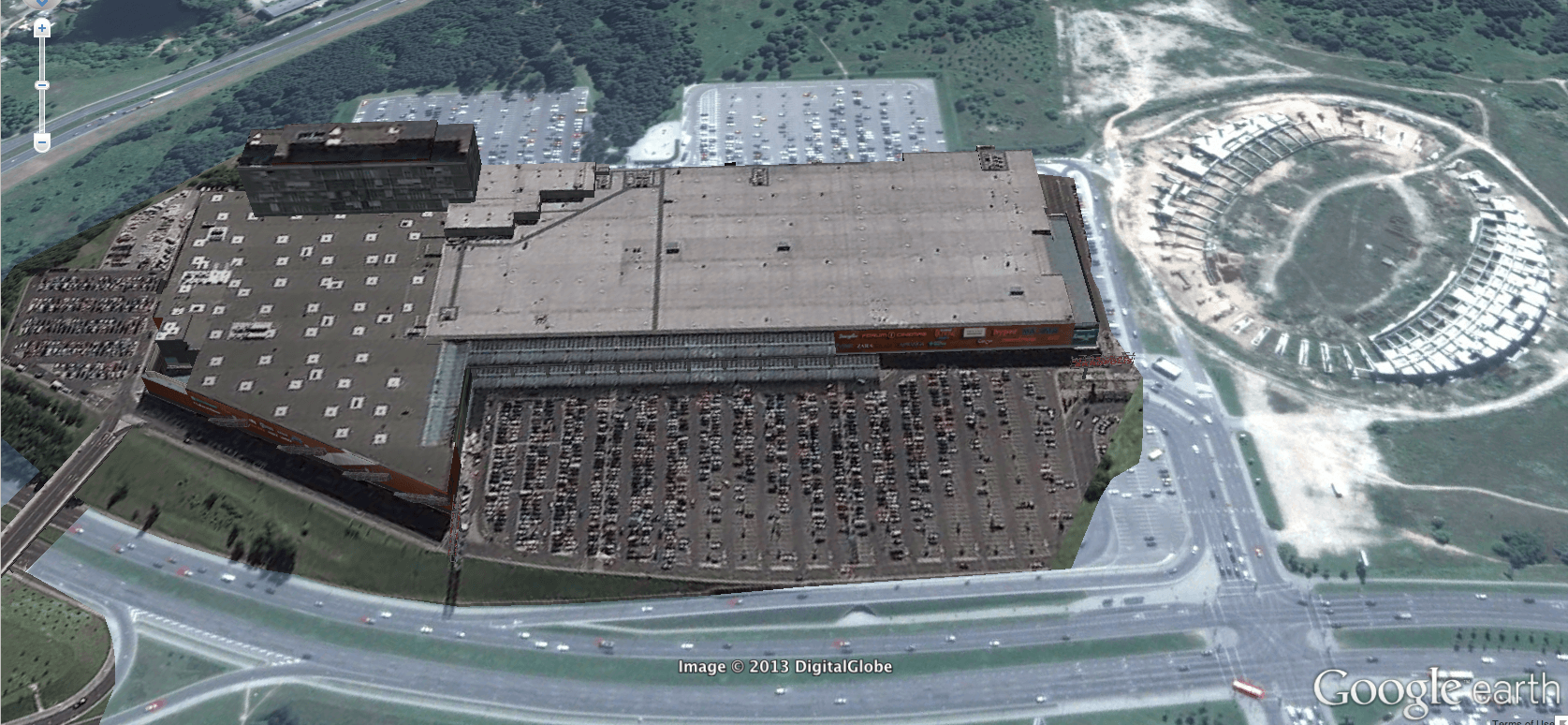
[ New mall adjacent to abandoned coliseum, Lithuania ]
There is a place in Vilnius where a gigantic shopping mall sits next to the site of a former soccer stadium, which now resembles ancient Greek ruins.
International capital also spurs the development of urban sprawl. These shopping centers bring with them a car centric lifestyle and a new set of infrastructure that requires more roads paved to build the suburban lifestyle. Essentially, the EU gave subsidies to the newly included countries earmarked to buy goods and infrastructure from the EU instead of locally, thus transferring public money into private hands. All the street lamps in Vilnius are brand new. Embellished on them is the local coat of arms, while on the opposite side is branding of the Italian company that made them.
Surprisingly, Belarus has seen a massive building boom in the last four years, the majority of which has been housing to accommodate the growing urban population. This has happened on the edges of the city, with high rises out of prefabricated concrete, much like in the soviet times. Even though it’s still possible to get free government apartments, there is a difference in quality to the ones that are privately funded by people who pool together the funds to have an apartment in the building once it’s finished. Foreign investment is low, because it is considered risky to do business there. The state has to own 51% of one’s enterprise.
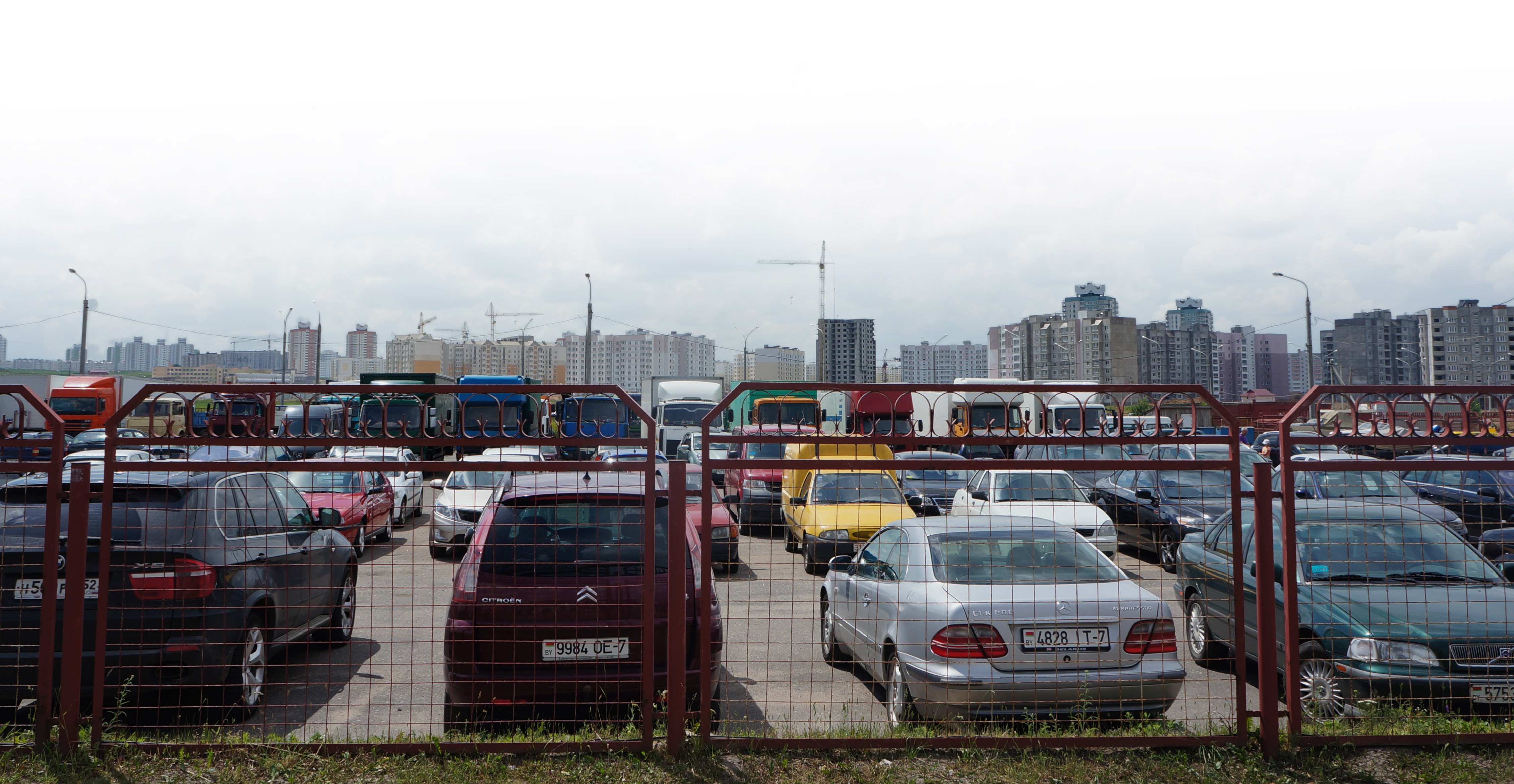
The rise car culture is a specific phenomenon; a social indicator about the projections of desires in a society. In Moscow, parking is outrageous. People often park on the sidewalk, right up to the edge of the building, leaving no place to walk for humans. The city was never designed for cars in mind to this capacity and hours long traffic of commuters at a standstill is absurdly impractical, however the car represents a pillar of all that is utopian about capitalism, the power of the individual and their infinite mobility over the masses and their environment. It is the deliverance though a status symbol. This practice points back to the decay of collective identities, where the split between the car and the pedestrian is created and thus a differentiation in value of one over the other is possible.
Speaking on the situation in Russia one can hardly do justice within the scope of a paragraph. However it is safe to say that Moscow and St. Petersburg are not really representative of Russia as a whole. They have become international cities, with a wealthy class that has more in common with the parallel strata of London, New York and Tokyo. These cities as a whole do not look to the rest of Russia for values. Wild capitalism of the 90’s ushered in an attitude of cognitive dissonance towards notions of social contract and social values that existed. The country as a whole subsists largely though it’s vast reserves of natural resources, namely oil and gas. As a result, institutional power is structures much like Saudi Arabia.
Cheap labor comes from Central Asia, mirroring the workers from the Central and South America in the United States. These are workers who fill the jobs that Russians no longer want to do because they pay is not enough to subsist on. Men from Russian villages come to Moscow to work as security guards, and consider this a better job because they don’t actually have to do anything.
There is a significantly large amount of people who one would consider upper middle class, enough so that they are able to buffer themselves from the reality of a vast underclass of people, for whom conditions have only worsened during the Russian Federation. The exterior of Russia exudes wealth, with it’s international investments and as an interlocutor of global trade. Meanwhile the interior of Russia maintains lives in stagnation.
The culmination of all these threads weave together a pattern, at the cusp of which is the “The Eastern Partnership” Association Agreement – the document which Ukraine backed out of signing with the EU. Here is the self-referential way in which it describes itself:
The package of economic reforms contained in the Association Agreement (AA)/ Deep and Comprehensive Free Trade Agreement (DCFTA) is tried and tested and has delivered economic benefits for every country that has signed a Free Trade Agreement (FTA) with the European Union in the past. And in the case of Deep and Comprehensive FTAs the approximation towards the European Union, its rules and standards will ensure that citizens share even greater benefits of better quality products and services.
A website Discoverukraine.ua frames the question of entering into The Partnership by asking: “Why does Europe need Ukraine?” This goes to imply that Ukraine’s need of Europe is unspoken, also that this is no longer up for decision or debate by people but once again occurs in the stratosphere of high politics.” The answer to this question by the EU ambassador to Ukraine, Jan Tombinski is as follows: “Ukraine is an important economic partner, a source of energy security, a bridge to Russia … its role as the main transit state for Russian oil and gas exports to Central and Western Europe, Ukraine is critical to European security. … So, it is quite natural for Europeans to aspire to expanding European, democratic values to their neighbors and, in particular, Ukraine.”
In the phrasing it is easy to see how this kind of mentality played it self out in establishing exploitative relationships to other Eastern republics that joined the EU. There is a similar mission that exists to Belarus of a policy based approach but of fundamentally different tone. Called the “European dialogue on the modernization of Belarus”. Here the EU is not interested in cooperating with current the government, instead it seeks to implement liberalization reforms though what it calls “the political opposition”. It’s three main objectives are:
(i) to develop a clearer understanding by the EU and by the Belarusian opposition and Civil Society on the vision of a modern and democratic Belarus, and on the necessary reforms to achieve the modernization of Belarus,
(ii)to clarify the related potential development of relations with the EU, based on the European Neighborhood Policy and the Eastern Partnership, as well as possible EU support in this regard;
(iii)for Belarusian stakeholders to gain practical knowledge and insight from EU Member States’ experiences as regards transition processes.
This classic use of the word “modernization” to implies a power dynamic inherent in the exchange of modernity, flowing from a source to a destination. What does modernization come to mean here? Brussels explains: Real independence for Belarus means “… A systematic reform will allow any international enterprise to do business in Belarus without asking its government for permissions. And a transformation of the political system will follow and mirror the economic processes.”
The notion of democratic values is used here in the tactical sense. Since the Iraq war, it became obvious that it is more effective to pursue this form of “regime change”. It has a cleaner public image and ultimately is more effective that military interventions, which are costly in lives and resources. It’s appeals of economic abundance to civil society and evocation of fundamental values in public relation campaigns speak to the notion of a global consensus on particular lifestyle as a unit of measure and it’s unquestionable desirably. This process is much more pernicious than Russian coercion or influence. Russia may present a show of force, but it cannot appeal to mass society to harness desire on this scale. The West sells a dream made tangible in units of capital, Russia can only offer second-rate signifiers of the same side of the coin.
Therein lies the problem of working with power and the self determination of people. So far, the focus has predominantly been on how to overthrow those presently in power, instead of overthrowing the system that exerts power from the outside. In this case it does not matter weather this power is the Russian shadow or the psychic hold of the EU. For some it may be too late to vocalize a discourse outside the paradigm of neoliberal democracy, they are in the same boat as the US now, facing the same set of problems. The lack of good options currently offered by opposition movements in the West make it seem like being on the other side of the discourse is a more hopeful option, even if presently that may be under the rule of a dictator, there are other exist strategies. At least people there have no illusions about representative democracy.